
When the Storms Start Talking
Discovering the Old Testament Behind Mark’s Story

“They were terrified and asked each other, ‘Who is this? Even the wind and the waves obey him!’” Mark 4:41
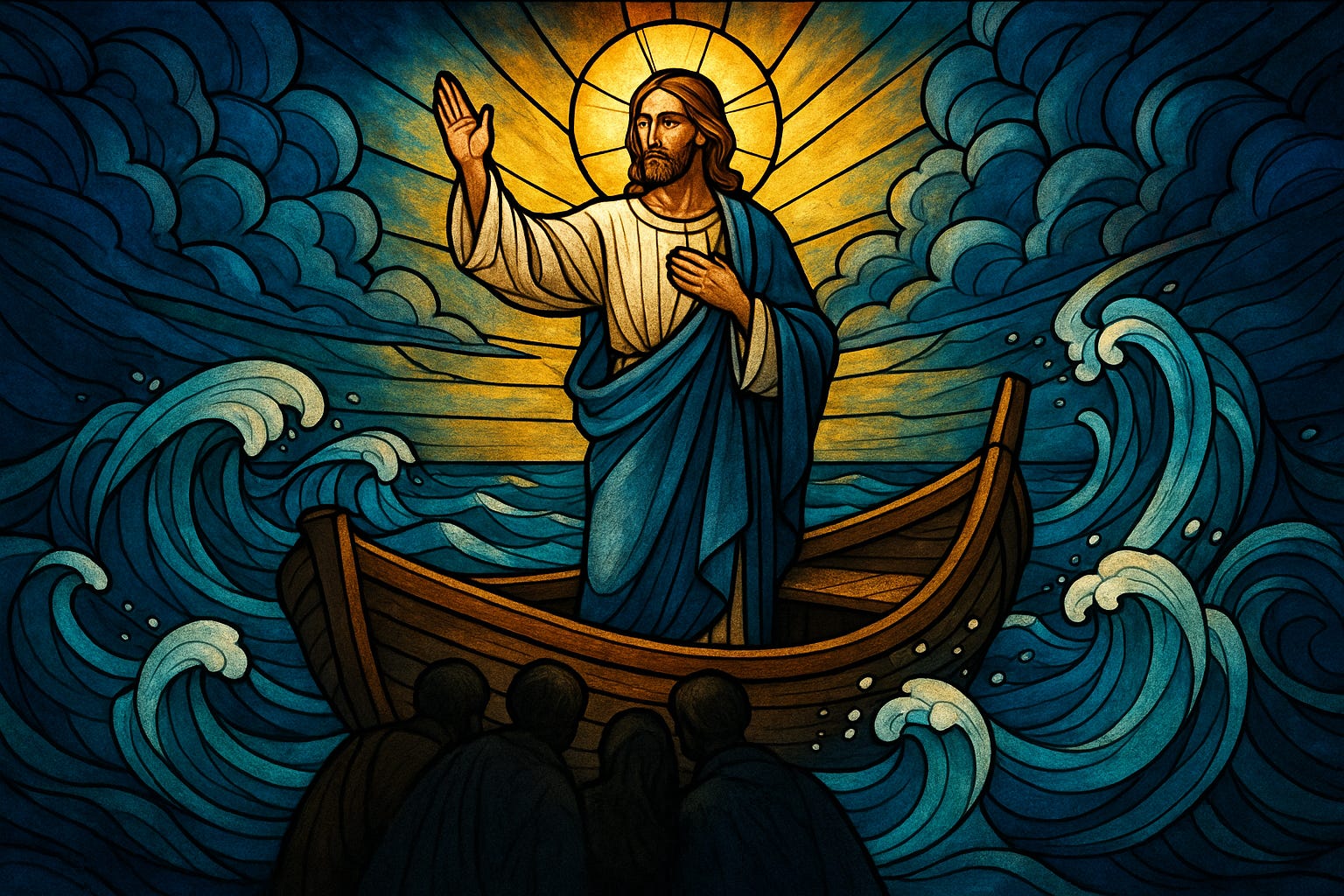
The Storm That Speaks
One of the most stunning moments in the Gospels happens when Jesus stands up in a sinking boat and hushes a hurricane with two words: “Quiet! Be still!” The storm obeys, and the sea becomes calm.
It’s a story most of us know but few realize that Jesus isn’t doing something new here.
He’s doing something old.
Something deeply biblical.
Mark 4:35-41 isn’t just a miracle story…it’s a revelation story. The wind and the waves are acting like characters in a much older story, one that began long before Jesus’ disciples ever took to the sea. And the more you read Scripture with your ears tuned to these echoes, the more the Bible opens up in living color.
1. Psalm 107: The God Who Still Stills the Storm
“Then they cried to the Lord in their trouble, and he brought them out of their distress.
He made the storm be still, and the waves of the sea were hushed.” Psalm 107:28-29
Centuries before Jesus, the psalmist told the story of sailors caught in a life-threatening storm. They cry out to God, and He stills the storm with His word. The result? Worship.
Mark’s audience would have recognized this. The disciples’ cry (“Teacher, don’t you care if we drown?”) mirrors the desperation of those ancient sailors. When Jesus speaks peace over the sea, He’s doing what Yahweh alone does in Psalm 107.
In other words: the sea recognizes its Creator’s voice.
2. Job 38: The God Who Sets Boundaries for Chaos
“Who shut up the sea behind doors when it burst forth from the womb… when I said, ‘This far you may come and no farther; here is where your proud waves halt’?” Job 38:8-11
In Job, God reminds the suffering man that He alone tamed the primal chaos of the waters at creation. For Israel, the sea symbolized disorder and danger, a force only God could control.
When Jesus rebukes the wind and says, “Be muzzled!” (pephímōso in Greek), He uses the same language He used earlier to silence demons. The storm, like chaos itself, submits to His word.
The One who once said, “This far you may come and no farther,” now stands in the boat and repeats the same command.
3. Jonah 1: The Sleeping Prophet and the Awake Lord
“But Jonah had gone below deck, where he lay down and fell into a deep sleep.” Jonah 1:5
Another familiar storm story. A prophet sleeps while sailors panic. They cry out in fear, asking what kind of man could cause such a storm.
The parallels are almost playful:
Both Jonah and Jesus are asleep in a boat.
Both are awakened by terrified sailors/disciples.
Both face a storm that threatens to destroy the ship.
Both bring peace to the sea, but in completely different ways.
Jonah must be thrown into the storm to calm it. Jesus simply speaks to it.
Jonah runs from God’s presence. Jesus reveals it.
Jonah’s descent brings temporary calm. Jesus’ authority brings new creation.
Jesus is the greater Jonah, not fleeing from God but embodying Him.

Why These Parallels Matter
Mark isn’t just giving us a dramatic sea story; he’s showing us who Jesus really is.
When the storm stops, the disciples ask, “Who is this?” and every Old Testament echo whispers the same answer:
He is the Lord who rules the seas.
In Hebrew thought, to command the waters is to command chaos itself. It’s to prove you’re not just a prophet or miracle worker, but the very presence of God among His people.
Learning to Listen for the Echoes
This story also gives us a model for reading the Bible deeply. The Gospel writers didn’t invent their imagery; they wove it out of Israel’s Scriptures. The more we recognize those threads, the more we see the Bible as one grand story instead of disconnected moments.
Here are a few steps to help you listen for these echoes:
Notice repetition. When a story or phrase sounds familiar, stop and ask, “Where have I heard this before?”
Follow cross-references. Look at your Bible’s margins, those tiny notes often point to the echo’s source.
Ask how the echo expands meaning. In Mark 4, seeing the Psalm 107 and Jonah links reveals that Jesus isn’t just calming nature, He’s unveiling His divine identity.
See how the old and new speak together. The New Testament never stands alone; it’s the continuation of a much older melody.
As N.T. Wright often says, the Gospels are “the climax of the story of Israel.” Every storm, every prayer, every promise finds its fulfillment in Jesus.
For Reflection
Which Old Testament echo speaks to you most: Psalm 107’s rescue, Job 38’s power, or Jonah 1’s grace?
How does seeing Jesus in these stories expand your sense of awe, the “fear of the Lord”?
Try reading another Gospel story this week and ask: Where have I heard this before? What might God be revealing through the echoes?
Closing Thought
When Jesus said “Quiet! Be still!” He wasn’t only calming a storm. He was answering generations of Scripture that had been waiting for Him to speak those words again.
And maybe He’s still speaking them, into your storms, your fears, your chaos, reminding you that the same voice that silenced the sea is the one that calls you to rest in awe and peace.