
Let Job Be Weird
Why one of the strangest books in the Bible might be one of the most important

In my last post, I made the case that we need to let the Bible be weird.
Not because it’s confusing for the sake of confusion, but because its strangeness is often part of how it teaches us. The Bible does not always behave like a tidy devotional handbook. It tells the truth through story, symbol, repetition, poetry, and sometimes through things that feel… unsettling.

And if you want a case study for that idea, you don’t have to look much further than the book of Job.
Because Job is weird. Not just a little weird. Deeply, structurally, theologically weird. And if we’re honest, it’s not just confusing. It can be frustrating.
Job is weird.
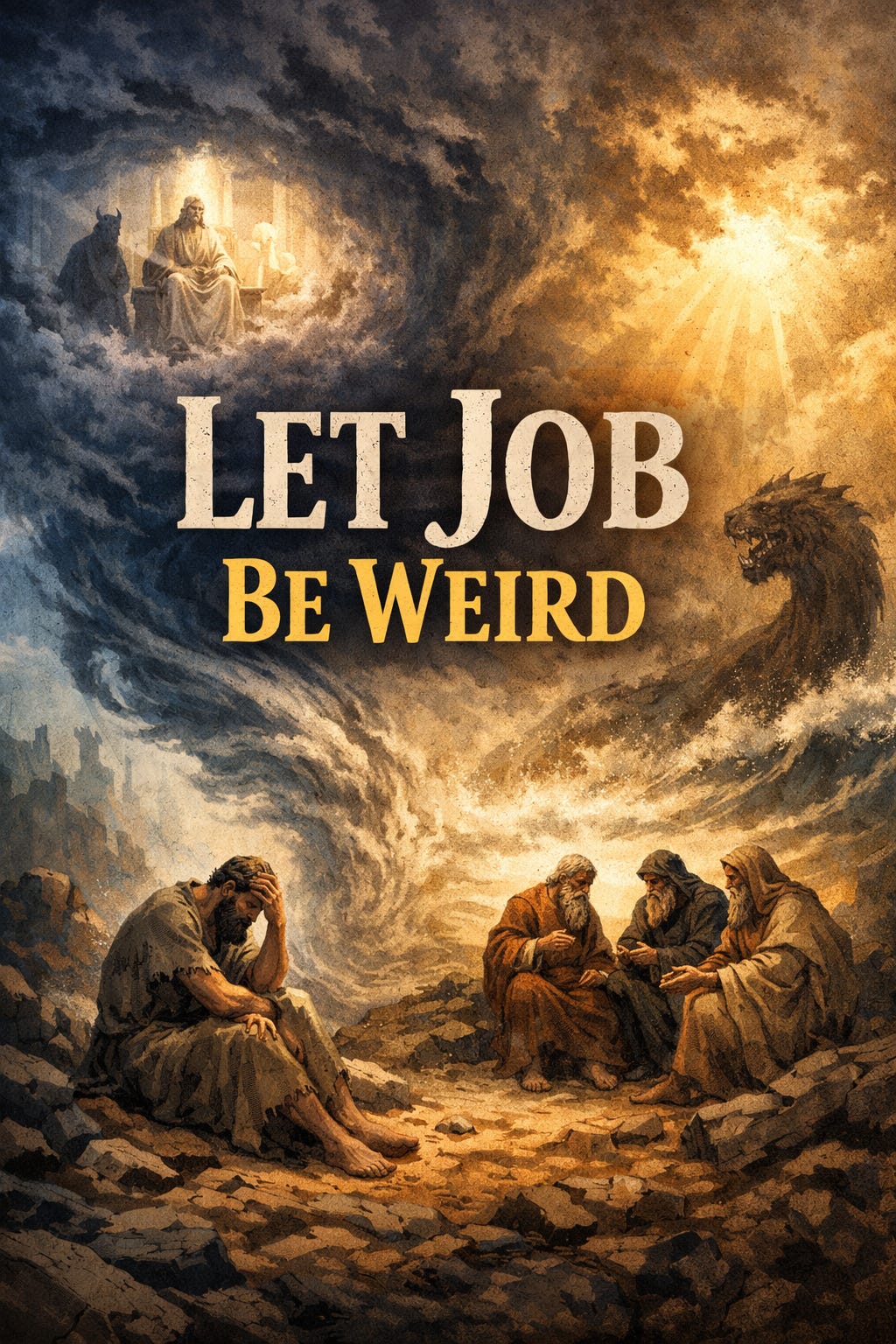
Job does not behave the way we want it to
A lot of us come to Job with a simple expectation. We assume it’s going to answer the question of suffering. Why do bad things happen to good people? That’s the question, right?
So we open the book, expecting clarity. And instead, we get something like this:
A heavenly courtroom scene where “the accuser” shows up and talks with God
A righteous man who loses everything in a cascade of disasters
Long cycles of speeches where Job’s friends say things that sound spiritual… but are mostly wrong
Job pushing back, lamenting, questioning, and refusing easy answers
And then, at the end, God shows up… and does not actually answer the question the way we expected
If you’re reading it like a modern reader looking for a clean explanation, Job can feel like a letdown. It doesn’t give you a neat, satisfying answer. It gives you something stranger.
The weirdness starts immediately
The opening chapters of Job are some of the most unique in all of Scripture.
We are pulled behind the curtain into a heavenly scene. God is there. The accuser is there. There is a conversation about Job’s righteousness, his faithfulness, and whether it will hold under pressure. That alone should stop us in our tracks.
The book is telling us something right away: There is more going on in the world than you can see.
There is more going on in the world than you can see.
Suffering is not always explained at the level where we experience it. There is a cosmic dimension to reality that we are not privy to. That is not a neat answer. That is a disruption.
And then, before we can get comfortable, Job loses everything. Not because he sinned. Not because he failed. But in the context of a reality we cannot fully see or understand.
Already, the book is refusing to play by the rules we prefer.
Job’s friends sound right… until they don’t
Then come the speeches. If you’ve read Job recently, you know what I mean. Chapters and chapters of dialogue. Job’s friends show up, and at first, they do something beautiful. They sit with him in silence. Blessed silence.
And then they start talking. And once they start talking, something goes wrong. Because what they say often sounds right.
They say things like:
God is just
God punishes the wicked
God rewards the righteous
You must have done something
If you pulled some of their lines out of context, they might even sound like something you’d hear in a sermon.
That’s part of what makes this section so strange. The problem is not that everything they say is technically false. The problem is that it is misapplied, overconfident, and ultimately wrong about Job.
They are trying to make the world make sense. They are trying to protect a system. They are trying to defend God in a way that actually misrepresents Him.
And the book lets them talk. For a long time. Like obnoxiously long. Which, again, feels weird.
Why not just correct them immediately? Why let all this back-and-forth go on? Because the book is doing something deeper than giving quick answers. It is exposing a way of thinking. A way of thinking that is still very alive today.
Job refuses easy answers
Job, for his part, refuses to accept their framework. He knows he has not done what they are accusing him of.
So he laments. He questions. He pushes back. He says things that make us uncomfortable. He wants an audience with God. He wants an explanation.
And here’s where it gets even more strange. The book does not shut Job down for asking hard questions. It lets him speak. It gives space to his grief, his confusion, his frustration.
That alone should reshape how we think about faith. Apparently, faithfulness is not the same thing as pretending everything makes sense.
Faithfulness is not the same thing as pretending everything makes sense.
And then God shows up…
After all the speeches, all the arguments, all the tension, God finally speaks.
This is the moment we’ve been waiting for. Surely now we will get the answer. Surely now everything will be explained.
And then God says… something very different.
Instead of explaining Job’s suffering, God asks questions.
Where were you when I laid the foundations of the earth?
Have you commanded the morning?
Can you bind the chains of the Pleiades?
Can you tame Leviathan?
In other words:
God does not give Job a step-by-step explanation. He gives Job a revelation of who He is. And that feels… unsatisfying, if we’re honest.
At least at first.
Because we want answers. God gives perspective.
We want explanation. God gives Himself.
This is where we’re tempted to “fix” the book
At this point, a lot of readers (and especially us preachers) feel the urge to clean things up.
To say:
“Well, what God really means is…”
Or:
“The lesson is simply…”
Or:
“Here’s the takeaway…”
And while there are certainly things we can learn from Job, there’s a danger here. We can rush past the strangeness. We can force the book into a neat summary. We can turn a deeply complex, unsettling, beautiful piece of Scripture into a few tidy principles. And in doing so, we may lose what the book is actually doing.
Let Job be weird
What if the point of Job is not to give us a clean answer to suffering? What if the point is to challenge our assumption that we should have one? What if the point is to expose how quickly we reach for explanations that are too small?
What if the point is to show us that:
The world is more complex than we think
God is more mysterious than we are comfortable with
Our systems for explaining suffering are often insufficient
Faithfulness includes trust even when understanding is partial
In other words, what if Job is not failing to answer the question…but redefining the conversation?

Jesus Doesn’t Answer the Question Either
What’s interesting is that Job is not the only place in Scripture where this question comes up. Jesus runs into it too.
In John 9, there’s a man born blind. And the disciples ask a very familiar question:
“Rabbi, who sinned, this man or his parents, that he was born blind?”
That question should sound familiar. It’s basically Job’s friends in a different setting. Someone is suffering. So there must be a clear explanation. Someone must be at fault. That’s how the system works.
But Jesus refuses the system. He answers:
“Neither this man nor his parents sinned… but this happened so that the works of God might be displayed in him.”
Now, that answer has its own layers and questions. We don’t want to rush past that either. But notice what Jesus does.
He does not give a detailed explanation of suffering.
He does not trace a neat cause-and-effect line.
He does not satisfy the disciples’ curiosity in the way they expect.
Instead, he redirects their attention.
From:
“Who is to blame?”
To:
“What is God doing here?”
That’s a very different question.
And then, and this is crucial, Jesus doesn’t just talk. He acts. He heals the man.
Which means the “answer” is not just an explanation. It’s a revelation. It’s restoration. It’s the breaking in of God’s kingdom right in the middle of human suffering.
In Job, God answers with a revelation of His greatness.
In John 9, Jesus answers with a revelation of His kingdom.
Neither one gives the kind of neat, philosophical explanation we often want. But both pull us into something deeper.
Job shows us that our understanding is limited and God is greater than we imagined.
Jesus shows us that God is not distant from suffering, He steps into it and begins to undo it. That doesn’t remove all the tension. But it reframes it. The question shifts from:
“Can I explain this?”
To:
“Can I trust God here… and watch for what He might do?”
And maybe that’s part of what it means to let the Bible be weird: not demanding that every question be answered on our terms, but learning to follow the story as it leads us… all the way to Jesus.
The Bible is not afraid to leave things unresolved
This may be one of the hardest things for modern readers to accept. We want closure. We want resolution. We want everything tied up neatly.
Job does not do that.
Yes, Job is restored.
Yes, God rebukes the friends.
Yes, there is a kind of resolution.
But the central “why” question is never answered in the way we expected.
And the Bible seems okay with that. That’s weird.
But maybe it’s also honest. Because if we’re paying attention, that’s often how life feels too.
Why this is actually good news
At first glance, Job’s weirdness can feel frustrating. I know it has often been for me. But I think it’s actually one of the reasons the book is so powerful.
Because a simpler book would:
give easy answers
flatten suffering
pretend everything can be explained
offer comfort without depth
Job refuses to do that.
Instead, it:
takes suffering seriously
refuses shallow explanations
allows space for lament
points us to a God who is present, powerful, and beyond our full comprehension
That kind of book is harder to read. But it’s also more trustworthy. Because it sounds more like the world we actually live in.
One final thought
If you’re reading the Bible and you come to Job and think:
“This is strange. This is unsettling. This doesn’t answer my questions the way I hoped.”
You’re not doing it wrong. You may actually be reading it well.
Job is one of those places where we have to resist the urge to make the Bible behave. We have to resist the urge to simplify too quickly. We have to let the tension sit. We have to let the questions breathe. We have to let God be God.
So maybe the invitation of Job is not:
“Here is the explanation you were looking for.”
Maybe the invitation is:
“Trust me, even here.”
And maybe that only works… if we let the Bible be weird.
Before you go, someone asked me the other day if “Let the Bible Be Weird” is turning into a series. I think it might be. Job alone gives us more than enough to keep going. I’ve even started outlining a short book around this idea. But I’d love to hear from you: what parts of the Bible have made you stop and think, “What do I even do with this?” There’s a good chance those are exactly the places we should go next.